
Recalibration Season: The Work Behind the Progress

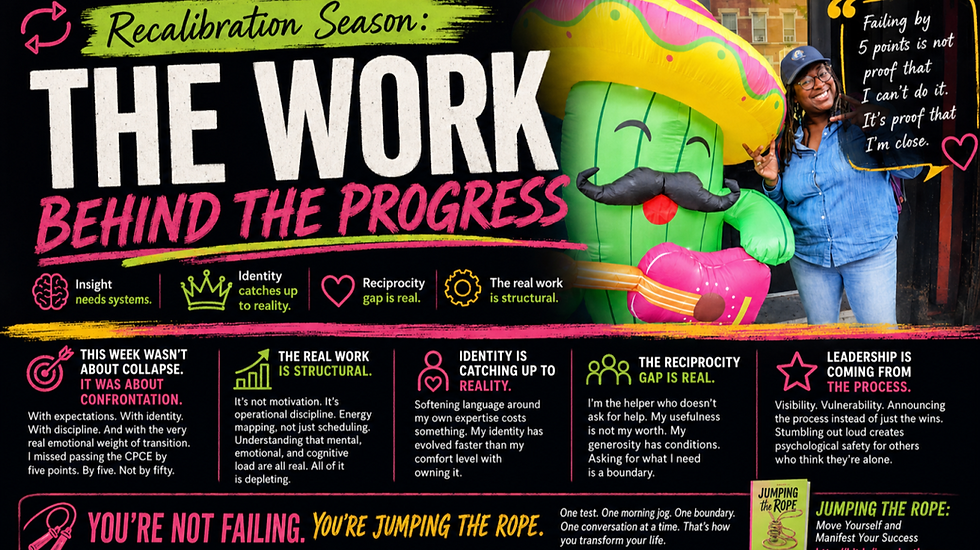
This week wasn't about collapse. It was about confrontation. With expectations. With identity. With discipline. And with the very real emotional weight of transition.
I missed passing the CPCE by five points. By five. Not by fifty.
And somewhere between the disappointment and the analysis, I learned something: failing by five points isn't proof that I can't do it. It's proof that I'm close. The foundation is already there.
But the foundation alone isn't the story I want to tell you about.
Understanding the Underdog Narrative
Recent research by Yan, McAllister, Lim, and Yam (2025) in the Academy of Management Review unpacks something critical: being labeled a workplace underdog is both stressful and challenging. Their integrated model of underdog trajectories reveals four distinct narratives, depending on how individuals interpret and manage the negative emotions that accompany underdog expectations.
The framework distinguishes between emotional activation (low or high) and cognitive appraisals (challenge or threat). And here's what matters: success or failure isn't a static endpoint. It's a process shaped by how we regulate our emotions and interpret our experiences.
I'm recognizing which underdog I'm becoming.
The Real Work Is Structural
I'm insightful. I know what distracts me. I know what procrastination looks like. I know my weak spots without needing anyone to point them out.
But insight without systems is just emotional exhaustion wearing a thinking cap.
This season taught me that the next level isn't about motivation. It's about operational discipline. It's about energy mapping, not just scheduling. It's about understanding that everything on your plate requires different forms of output: mental energy, emotional energy, and cognitive load. All of it is real. All of it is depleting.
You can't operate at peak capacity while carrying grad school, an internship, trauma coursework, comprehensive exam prep, parenting, and work. And if you're expecting yourself to, you're already losing.
The research suggests that strategic underdogs succeed by managing their emotions effectively and by reappraising challenges as opportunities rather than threats. That requires systems. That requires honesty about your actual capacity.
Identity Is Catching Up to Reality
Here's what I noticed myself doing: softening language around my own expertise.
"Kind of therapy but not therapy."
But I'm functioning in therapeutic spaces with clinical thinking, emotional regulation strategies, psychoeducation, reflection, and relational processing. My identity has evolved faster than my comfort level with owning it.
That gap costs something.
And I'm not the only one carrying this. So many people are building expertise, stepping into leadership, designing their next chapter, and still introducing themselves with apologies baked into the introduction. We're underdogs who haven't given ourselves permission to own our progress.
The Reciprocity Gap Is Real
I'm the helper who doesn't ask for help. When I needed support and no one stepped up, it broke something. And I finally named it: "I'm always the helper, but not the helped."
High-capacity people do this. We become so invested in showing up for others that we stop believing we're worth showing up for. We measure our worth by what we produce, by how useful we are, by whether we can solve the problem without burdening anyone else.
But here's what I know now: my usefulness is not my worth. My generosity has conditions. And asking for what I need isn't a weakness. It's a boundary.
What the research calls "overcomers" are underdogs who successfully defy expectations not through perfectionism but through emotional regulation and reframing threat as challenge. They ask for help. They adjust systems. They own their evolution.
What I'm Actually Building
Leadership isn't coming from a title. It's coming from visibility, from vulnerability, from the willingness to announce the process instead of just the wins.
Most people celebrate their victories. I announced my stumble. And that created psychological safety for other people who are struggling quietly, thinking they're the only ones who fail, who doubt, who wonder if they're close enough or good enough.
They're not building a career like everyone else. They're building a philosophy, a voice, a framework. They're building a legacy tied to reinvention and emotional honesty.
That's bigger than a job description.
And if you're in the middle of your own recalibration right now—if you're questioning whether you're close enough, whether five points away means you're ready, whether your expertise counts even if it looks different than you expected—I want you to know this:
The journey of reinvention isn't about perfection. It's about the people who dream about transformation and the people who actually do it. It's about what happens after the stumble. Do you keep moving? Do you build systems? Do you start owning what you've already built?
If you are, then you're not failing.
You're becoming an overcomer. You're jumping the rope, moving yourself, and manifesting your success. That's what I wrote about in my book "Jumping The Rope: Move Yourself and Manifest Your Success" (http://bit.ly/jumpingtherope), and it's what I'm living through right now.
One test. One morning jog. One boundary. One conversation at a time.
That's how you transform your life. That's how you go from the underdog narrative you inherited to the one you actively choose.


Comments